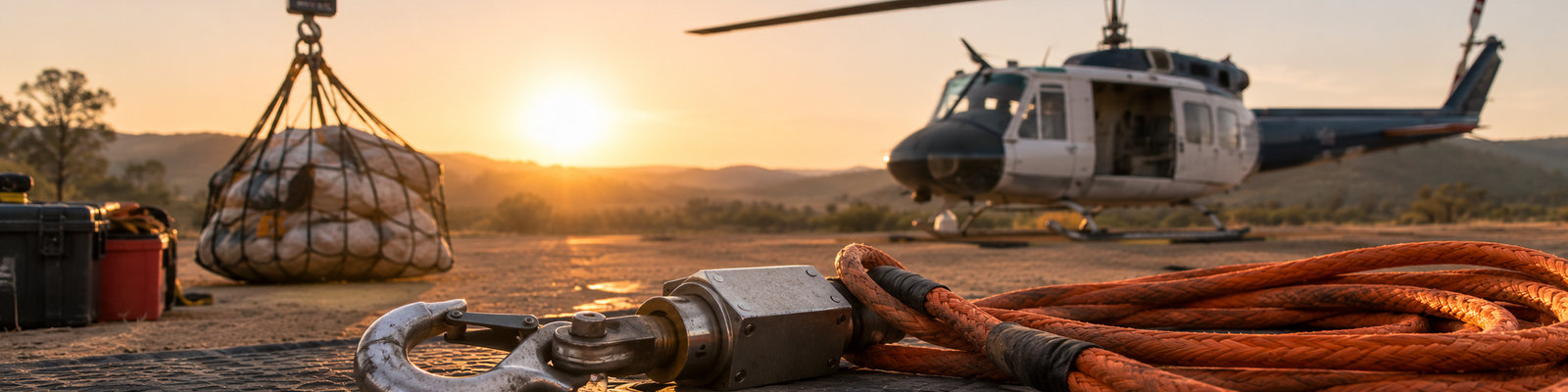
What we know and do not know. The NTSB has determined no cause for the CH-54A accident in Utah or for the K-MAX accident in July. The preliminary reports describe turns and passes at low level near rising terrain or a water source, and a helicopter lost within seconds of a radio call. We draw no conclusion from that. The value for a risk owner is in the controls any operator would want around work like it.
The numbers point to severity, not frequency. The FAA’s data for October to August show external-load operations were 5% of rotorcraft accidents but 19% of fatal ones, and both US-registered fatal accidents in August were in firefighting. When this kind of work goes wrong, it tends to go wrong badly, which is a reason to test the controls rather than rely on a low accident rate.
Repetition uses up margin and component life. The FAA’s new limits on S-61-family main rotor shafts are written in lift cycles as well as hours, with separate lives for repetitive external lift. Regulators treat repeated lifting as its own exposure, and operators should be able to show cycle counts, not only hours, on the records that support the contract.
The contract model decides what you can see. The Utah helicopter flew under an exclusive-use contract and the July K-MAX under a call-when-needed contract. Whatever the model, the organisation that contracts the flying still owns the question of whether the operator’s controls work on its own sites, and the answer should be in the scope and the audit rights.
Six controls to verify for firefighting and heavy-lift contracts
Mapped to BARS (CAO v11) · SWA services
VERIFYDoes it work here, today?
PRIORITISEWhat matters most?
CONTROLWhat keeps it working?
ASSUREIs it still working?
Verify the crew and the procedure fit the actual job
Confirm that pilots meet the operator’s external-load experience and annual check requirements for the technique, line length and terrain on your site, and that the standard procedures were agreed with ground crew in a pre-start risk assessment. Test it by asking for the records and the last pre-start assessment for a job like yours.
BARSCAO v11 · Control 23.1 Pilot Experience; 23.4 Standard Operating Procedures
SWAOperational reviews
Find where the margin is thinnest: loads, wind, terrain and cycles
Rank your contracted lifts and drops by load margin, wind and terrain exposure, and cycles flown. Confirm accurate weights reach the pilot before each lift, and that component records follow cycles where an AD or the manufacturer sets lives that way.
BARSCAO v11 · Control 23.6 Load Weight; Common Control 1.15 Operational Risk Assessment
SWAAviation exposure baseline and risk profile
Hold the human limits: flight times and flight following
Check the operator applies the external-load flight-time limits where moves exceed three per hour, and that someone on the ground knows the aircraft’s position and takes operation-normal calls at set intervals. Test it against a recent day’s records, not the manual.
BARSCAO v11 · Control 23.2 Pilot Daily Flight Times; Defence 29.2 Flight Following
SWAOperator endorsement and contracting support
Make component lives follow how the aircraft is flown
Where an AD or manufacturer sets a life by lift cycles, confirm the operator counts them and name who checks the records.
BARSCAO v11 · Control 10.10 Critical Maintenance Tasks and Independent Inspections
SWACritical control verification
Write the controls into the contract
Put the checks above into the scope of work and the audit rights, whichever contract model you use, so they can be tested without a dispute.
BARSCAO v11 · Common Control 1.3 Approved Aircraft Operator
SWAOperator endorsement and contracting support
Review recorded data and near-limit events routinely
Look at image, flight and tracking data against agreed triggers on ordinary days, and act on trends before an event forces the question.
BARSCAO v11 · Common Control 1.13 Aircraft Operator SMS
SWASpecialist aviation advisory
Critical controls that matter this month
Four of the five critical controls bear on this work. Fuel does not feature this month.
Personnel
Hard, repetitive work with a long line. Ask whether pilots hold current long-line, low-level and terrain recency for your site, and check duty and rest records against the contract’s flying hours, because a firefighting day is many short cycles.
BARSCAO v11 · Control 23.1 Pilot Experience; Control 23.2 Pilot Daily Flight Times
Aircraft
The S-61-family shaft limits are written in lift cycles as well as hours. Ask whether the operator counts cycles, shows the count on the records that support your contract, and that each aircraft is configured for external load (hook, mirrors, load measurement) as the contract requires.
BARSCAO v11 · Control 10.10 Critical Maintenance Tasks and Independent Inspections; Common Control 1.8 Basic Aircraft Equipment Fit
Weather
At a water source or fire front the crew needs actual wind and temperature, not a regional forecast. Check the contract sets wind and density-altitude limits for bucket and long-line work, and that they are briefed.
BARSCAO v11 · Control 2.6 Destination Weather Reporting; Control 23.6 Load Weight
Infrastructure
Water-dip sites and helibases are part of the operating environment. Check that each pond, tank or reservoir was assessed for obstacles, approach path and rising terrain before first use, and that a pre-start risk assessment is on file.
BARSCAO v11 · Control 2.3 Landing Site Assessments; Common Control 1.15 Operational Risk Assessment
Close the loopInside your own organisation, the person who manages the firefighting or heavy-lift contract should pass lift-cycle counts, flight-time exceptions, wind and density-altitude stand-downs and water-site assessments to the executive who accepts the risk, and the executive’s decisions back down to the project and incident managers who task the aircraft. That way a request for one more drop meets the same limits the board has accepted, and crews are not asked to trade them away on the day.